
Reader actions
Save, share, or follow this file
These controls use CWI's existing public metrics system. No supporter or donation numbers are shown here.
Views
0
Shares
0
Likes
0
Saves
0
Short answer
Joshimath Land Subsidence is tracked because available public records show unresolved questions around responsibility, public harm, official response, or accountability.
Background
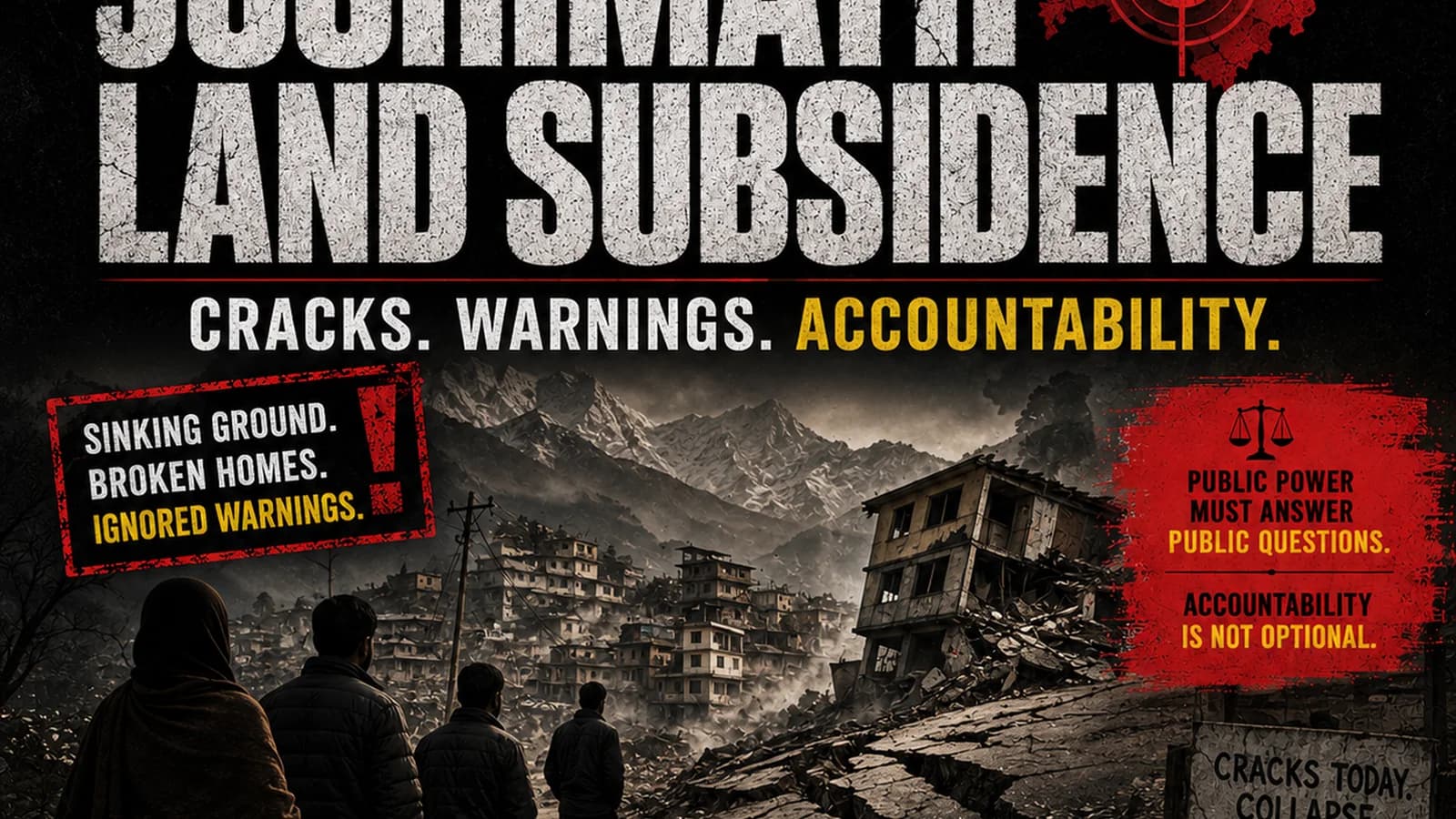
Joshimath became a symbol of Himalayan development without enough risk accountability: cracks came first, answers came later.
People affected
Residents, shopkeepers, hotel workers, pilgrims, displaced families
Main issue
Land subsidence, unsafe buildings, construction pressure, compensation, and rehabilitation.
Ground reality
Residents faced cracked homes, uncertain compensation, livelihood loss, and fear that warnings about fragile Himalayan development were acted on too late.
Official response
The state identified unsafe structures, moved some residents, announced relief measures, and courts pushed for expert assessment and construction restrictions.
Timeline
How the file developed
Cracks widen
Residents reported widening cracks in homes, roads, and hotels.
Sources 2
Unsafe buildings identified
Authorities marked buildings unsafe and moved affected people into temporary accommodation.
Sources 2
Court scrutiny
Courts discussed expert studies and construction restrictions in the affected area.
Sources 1
Rehabilitation questions
The larger questions moved to compensation, safe relocation, and future development limits.
Sources 1
Background pressure builds
The file begins with the deeper social, legal, governance, or ecological context behind Joshimath Land Subsidence. CWI treats this as the starting point because public harm rarely begins on the first headline date.
Sources 1
People affected become central
Residents, shopkeepers, hotel workers, pilgrims, displaced families became central to the public-interest record as the issue moved from a dispute or incident into a larger question of rights, rehabilitation, trust, or justice.
Sources 2
Government response recorded
The state identified unsafe structures, moved some residents, announced relief measures, and courts pushed for expert assessment and construction restrictions.
Sources 1, 2
Ground reality checked
Residents faced cracked homes, uncertain compensation, livelihood loss, and fear that warnings about fragile Himalayan development were acted on too late.
Sources 2
What CWI knows
What happened?
Joshimath saw sudden and visible land subsidence, with cracks appearing in homes, roads, hotels, and public structures.
Why it matters
The case raises the cost of ignoring geology, hydrology, unplanned construction, and infrastructure pressure in the Himalayas.
Human cost
Families lost the safety of home, workers lost livelihood certainty, and residents were forced to negotiate relief while living with fear.
What remains unanswered
Was the construction ban enforced strongly enough?
Were residents compensated transparently?
What projects were reviewed after the disaster?
What happens to families whose homes remain unsafe?
Legal/current status if available
The Supreme Court asked the petitioner to approach the Uttarakhand High Court, noting overlap with proceedings there.
Official response if available
The state identified unsafe structures, moved some residents, announced relief measures, and courts pushed for expert assessment and construction restrictions.
Why it matters
Land subsidence, unsafe buildings, construction pressure, compensation, and rehabilitation.. The open question is: Why were warnings about Joshimath's fragility not converted into prevention before homes cracked?
Sources and further reading
Source trail
Each source is listed with what it supports. Sources do not prove more than their own record shows.
Supreme Court asks petitioner to move Uttarakhand High Court
The Indian Express
Court-linked reporting on petitions, expert studies, and construction restrictions.
ISRO images show Joshimath sank over 5 cm in 12 days
The Indian Express
Satellite and administrative developments during the January 2023 crisis.
CWI note
CWI does not treat this file as a legal finding. The record should be read as public-interest tracking with source limits, open questions, and correction paths visible.
Related Live Newsroom updates
Current updates
Developing
Bharat Tiwari Encounter Case: What We Know, What Is Alleged, and What Still Needs Answers
Bharat Bhushan Tiwari's death after a reported police/STF encounter in Bhojpur has triggered serious public questions. Police describe self-defence during an armed threat; family members reportedly allege he had surrendered or thrown away his weapon before being shot.
Developing
CJP After June 13: Ultimatum Expires, State-by-State Student Mobilisation Begins
CWI updates the record through June 14: the June 13 resignation ultimatum has passed, with CJP-linked protests reported or planned in Pune, Lucknow, Amritsar, Bengaluru and Jaipur.
Source-backed
Pune to Lucknow: CJP's Exam-Accountability Protest Moves Into Regional Student Hubs
Pune SPPU and Lucknow Eco Garden reports show the movement expanding from a Delhi-centred protest into regional student and aspirant networks.
Public comments
Comments are moderated
Do not post private data, threats, hate, or unsupported allegations as fact.
Comments and public context
Comments are moderated and only approved real submissions appear publicly. No hate, threats, doxxing, personal information, harassment, or unverified allegations presented as fact.
No comments yet. Be the first to add context.
Correction open
Seen a source, correction, or update?
Send CWI the link, date, creator credit, or missing context. Do not submit private data, threats, hate, or unverified allegations as fact.