
Reader actions
Save, share, or follow this file
These controls use CWI's existing public metrics system. No supporter or donation numbers are shown here.
Views
0
Shares
0
Likes
0
Saves
0
Short answer
Hasdeo Aranya Coal Mining and Adivasi Protests is tracked because available public records show unresolved questions around responsibility, public harm, official response, or accountability.
Background
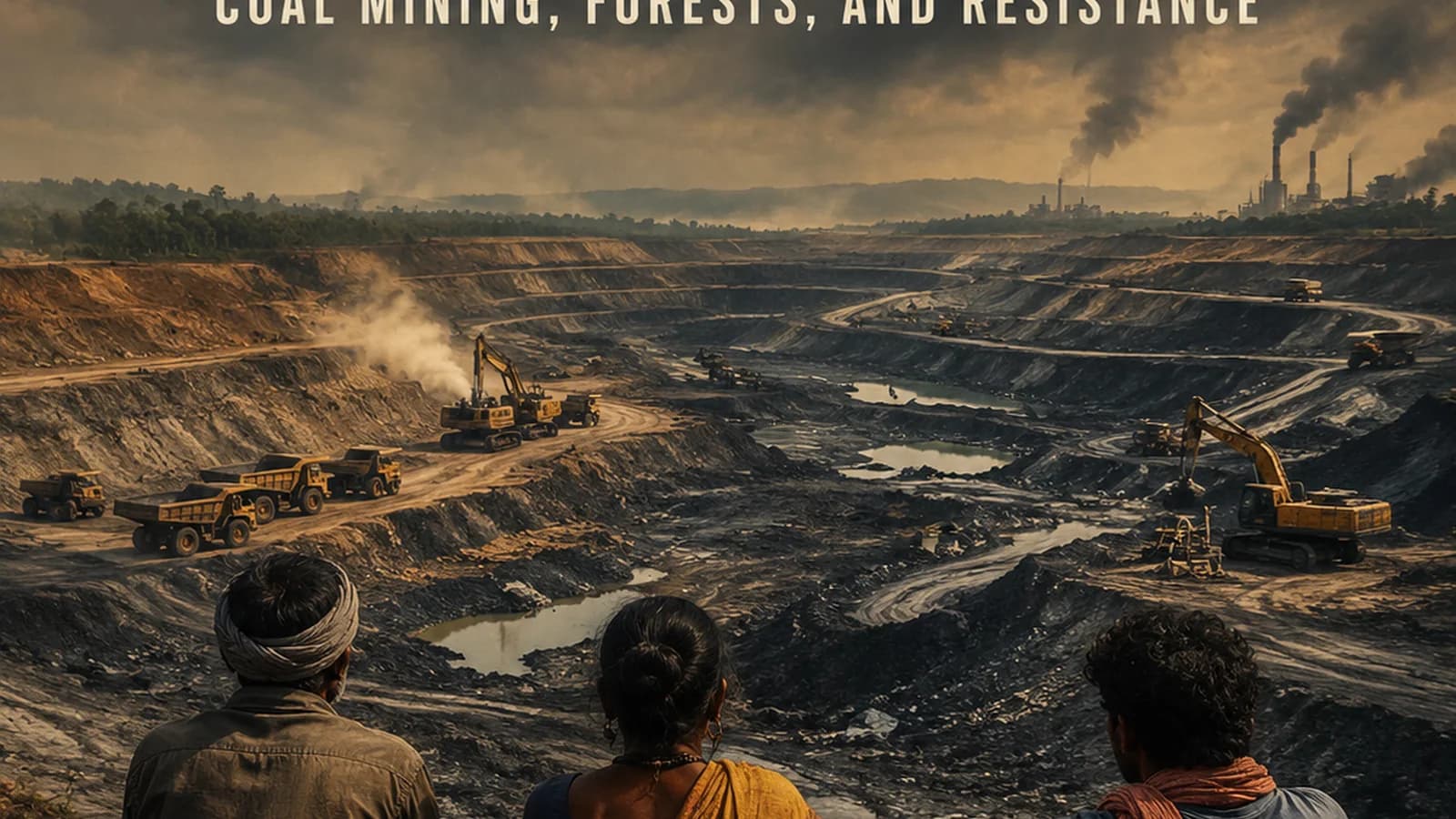
Hasdeo Aranya asks whether energy policy can be legitimate when forest communities say their land and consent were not respected.
People affected
Adivasi villages, forest-dependent communities, wildlife corridors
Main issue
Coal mining clearances, forest diversion, consent claims, Adivasi protest, and ecological damage.
Ground reality
Adivasi groups and environmental campaigners argue that forest loss, elephant conflict, livelihood damage, and consent disputes remain unresolved.
Official response
State and central authorities have defended coal extraction through approvals and energy-supply arguments, while different governments have also issued conflicting political signals.
Timeline
How the file developed
Coal blocks contested
Hasdeo became a long-running forest-rights and mining conflict.
Sources 2
Assembly resolution politics
Chhattisgarh politics saw conflicting signals around cancellation and continuation of coal blocks.
Sources 1
Protests return
Adivasi and civil society groups protested renewed cutting and mining activity.
Sources 1
Background pressure builds
The file begins with the deeper social, legal, governance, or ecological context behind Hasdeo Aranya Coal Mining and Adivasi Protests. CWI treats this as the starting point because public harm rarely begins on the first headline date.
Sources 1
People affected become central
Adivasi villages, forest-dependent communities, wildlife corridors became central to the public-interest record as the issue moved from a dispute or incident into a larger question of rights, rehabilitation, trust, or justice.
Sources 1, 2
Government response recorded
State and central authorities have defended coal extraction through approvals and energy-supply arguments, while different governments have also issued conflicting political signals.
Sources 1
Ground reality checked
Adivasi groups and environmental campaigners argue that forest loss, elephant conflict, livelihood damage, and consent disputes remain unresolved.
Sources 1, 2
Court and legal record tracked
Forest clearance, gram sabha consent, and environmental approval questions remain central to legal and administrative scrutiny.
Sources 1, 2
What CWI knows
What happened?
Hasdeo Aranya has seen long-running protests against coal mining in forest areas inhabited by Adivasi communities.
Why it matters
The case links energy demand to forest rights, consent, biodiversity, elephants, livelihoods, and state accountability.
Human cost
Villagers fear loss of forest, land, water, livelihood, and cultural continuity tied to the forest.
What remains unanswered
Were consent processes genuinely free and informed?
What is the full ecological cost of mining?
How are elephant corridors and water systems protected?
Why do protection promises keep colliding with approvals?
Legal/current status if available
Forest clearance, gram sabha consent, and environmental approval questions remain central to legal and administrative scrutiny.
Official response if available
State and central authorities have defended coal extraction through approvals and energy-supply arguments, while different governments have also issued conflicting political signals.
Why it matters
Coal mining clearances, forest diversion, consent claims, Adivasi protest, and ecological damage.. The open question is: Whose consent counts when forests, coal, power demand, and Adivasi land rights collide?
Sources and further reading
Source trail
Each source is listed with what it supports. Sources do not prove more than their own record shows.
CWI note
CWI does not treat this file as a legal finding. The record should be read as public-interest tracking with source limits, open questions, and correction paths visible.
Related Live Newsroom updates
Current updates
Developing
Bharat Tiwari Encounter Case: What We Know, What Is Alleged, and What Still Needs Answers
Bharat Bhushan Tiwari's death after a reported police/STF encounter in Bhojpur has triggered serious public questions. Police describe self-defence during an armed threat; family members reportedly allege he had surrendered or thrown away his weapon before being shot.
Developing
CJP After June 13: Ultimatum Expires, State-by-State Student Mobilisation Begins
CWI updates the record through June 14: the June 13 resignation ultimatum has passed, with CJP-linked protests reported or planned in Pune, Lucknow, Amritsar, Bengaluru and Jaipur.
Source-backed
Pune to Lucknow: CJP's Exam-Accountability Protest Moves Into Regional Student Hubs
Pune SPPU and Lucknow Eco Garden reports show the movement expanding from a Delhi-centred protest into regional student and aspirant networks.
Public comments
Comments are moderated
Do not post private data, threats, hate, or unsupported allegations as fact.
Comments and public context
Comments are moderated and only approved real submissions appear publicly. No hate, threats, doxxing, personal information, harassment, or unverified allegations presented as fact.
No comments yet. Be the first to add context.
Correction open
Seen a source, correction, or update?
Send CWI the link, date, creator credit, or missing context. Do not submit private data, threats, hate, or unverified allegations as fact.