
Reader actions
Save, share, or follow this file
These controls use CWI's existing public metrics system. No supporter or donation numbers are shown here.
Views
0
Shares
0
Likes
0
Saves
0
Short answer
Electoral Bonds and Political Funding Transparency is tracked because available public records show unresolved questions around responsibility, public harm, official response, or accountability.
Background
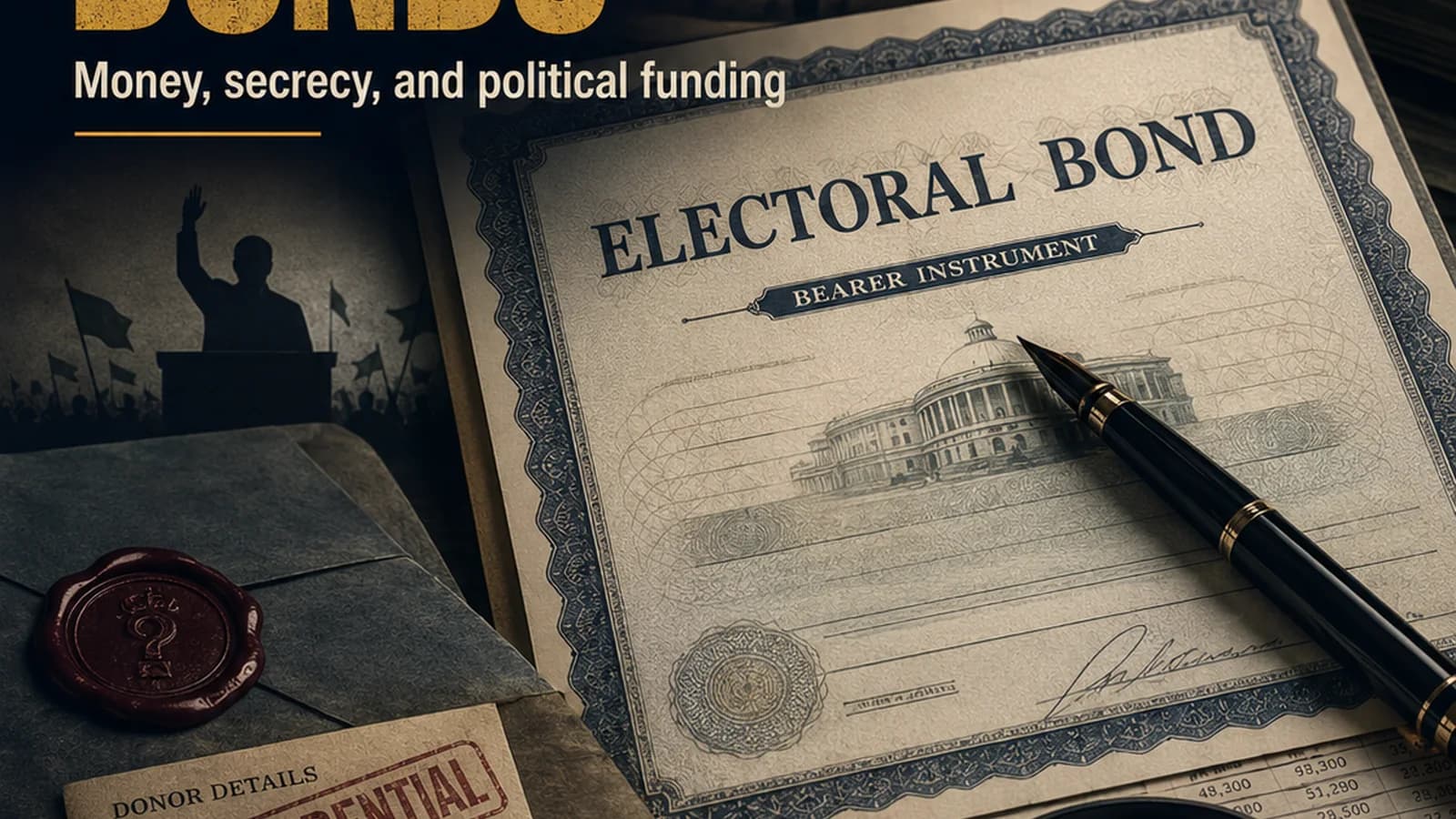
Electoral bonds forced India to confront a simple democratic question: can voters judge parties without knowing who funds them?
People affected
Voters, political parties, donors, public institutions
Main issue
Anonymous political funding, voters' right to know, corporate influence, and transparency.
Ground reality
The Supreme Court struck down the scheme as unconstitutional and ordered disclosure, turning political finance into a major transparency file.
Official response
The government defended electoral bonds as a cleaner alternative to cash donations and argued the scheme could protect donor privacy.
Timeline
How the file developed
Scheme begins
Electoral bonds became a route for political donations through banks.
Sources 1
Scheme struck down
The Supreme Court held the scheme unconstitutional.
Sources 1
Disclosure fight
The court rejected SBI's extension plea and pushed disclosure of donor details.
Sources 2
Background pressure builds
The file begins with the deeper social, legal, governance, or ecological context behind Electoral Bonds and Political Funding Transparency. CWI treats this as the starting point because public harm rarely begins on the first headline date.
Sources 1
People affected become central
Voters, political parties, donors, public institutions became central to the public-interest record as the issue moved from a dispute or incident into a larger question of rights, rehabilitation, trust, or justice.
Sources 1
Government response recorded
The government defended electoral bonds as a cleaner alternative to cash donations and argued the scheme could protect donor privacy.
Sources 1
Ground reality checked
The Supreme Court struck down the scheme as unconstitutional and ordered disclosure, turning political finance into a major transparency file.
Sources 1
Court and legal record tracked
The Supreme Court struck down the scheme and ordered disclosure processes.
Sources 1, 2
What CWI knows
What happened?
The Supreme Court struck down the electoral bonds scheme, holding that anonymous political funding violated voters' right to information.
Why it matters
Political money shapes policy, access, and public trust. Without disclosure, voters cannot judge conflicts of interest.
Human cost
The cost is democratic rather than individual: citizens vote without knowing financial networks behind parties.
What remains unanswered
Will India create real-time political funding disclosure?
How will quid-pro-quo concerns be investigated?
Will all parties support transparent funding reform?
What safeguards prevent another opaque system?
Legal/current status if available
The Supreme Court struck down the scheme and ordered disclosure processes.
Official response if available
The government defended electoral bonds as a cleaner alternative to cash donations and argued the scheme could protect donor privacy.
Why it matters
Anonymous political funding, voters' right to know, corporate influence, and transparency.. The open question is: What replaced the scheme, and will voters get real-time transparency on political money?
Sources and further reading
Source trail
Each source is listed with what it supports. Sources do not prove more than their own record shows.
CWI note
CWI does not treat this file as a legal finding. The record should be read as public-interest tracking with source limits, open questions, and correction paths visible.
Related Live Newsroom updates
Current updates
Developing
Bharat Tiwari Encounter Case: What We Know, What Is Alleged, and What Still Needs Answers
Bharat Bhushan Tiwari's death after a reported police/STF encounter in Bhojpur has triggered serious public questions. Police describe self-defence during an armed threat; family members reportedly allege he had surrendered or thrown away his weapon before being shot.
Developing
CJP After June 13: Ultimatum Expires, State-by-State Student Mobilisation Begins
CWI updates the record through June 14: the June 13 resignation ultimatum has passed, with CJP-linked protests reported or planned in Pune, Lucknow, Amritsar, Bengaluru and Jaipur.
Source-backed
Pune to Lucknow: CJP's Exam-Accountability Protest Moves Into Regional Student Hubs
Pune SPPU and Lucknow Eco Garden reports show the movement expanding from a Delhi-centred protest into regional student and aspirant networks.
Public comments
Comments are moderated
Do not post private data, threats, hate, or unsupported allegations as fact.
Comments and public context
Comments are moderated and only approved real submissions appear publicly. No hate, threats, doxxing, personal information, harassment, or unverified allegations presented as fact.
No comments yet. Be the first to add context.
Correction open
Seen a source, correction, or update?
Send CWI the link, date, creator credit, or missing context. Do not submit private data, threats, hate, or unverified allegations as fact.